Rethinking Grades
From numbers to narratives

Next week, my Spanish 4 Honors students will complete their first argumentative writing task of the year, based on a short story from El Conde Lucanor. It’s one of my favorite assignments because students engage deeply with complex ideas while navigating the challenge of expressing abstract thought in Spanish. Many instinctively attempt to transfer their English writing style into Spanish—a process that is both frustrating and illuminating. It pushes them to confront the structures of the language, and though demanding, it often leads to some of their most meaningful growth.
This year, I’m approaching the task a bit differently.
Questioning the Numbers
About two years ago, I realized I was increasingly dissatisfied with how my students were progressing as writers in Spanish—and, more specifically, with how traditional grading represented that growth. I was using the gradebook as expected, but the numerical system began to feel hollow. What does a 90 actually communicate? How is it substantively different from a 91? Those questions caused more confusion for me and more anxiety for my students.
Yes, rubrics can help. Counting linguistic errors can help. But ultimately, I found that my students were not receiving feedback that truly advanced their learning. The process became less about engaging with writing and more about chasing a number.
After reading David Clark and Robert Talbert’s Grading for Growth, I began to rethink my entire approach. Their framework—rooted in clearly defined standards, feedback-oriented evaluation, marks that signal progress rather than judgment, and opportunities for reassessment—deeply resonated with me.
While I recognize that many students remain motivated by grades, I have become convinced that excessive granularity—the obsession with decimal points and letter thresholds—can actually impede learning. It shifts the focus from what a student can do to how a score is calculated.

Experimenting with Alternatives
In the past two years, I’ve experimented with several models:
Contract grading, where completing the required work earns top marks.
Standards-based grading, where students are evaluated against defined learning outcomes.
Both approaches offered value but left me wanting something more balanced—something that allowed me to highlight specific dimensions of writing (accuracy, complexity, expressiveness) without overwhelming either the students or myself.
Notably, most of my experimentation has been in senior-level, non-honors classes, where students tend to embrace new structures with curiosity. Honors-level 11th graders, in contrast, often approach grading reforms with a more critical eye. This awareness shaped my latest iteration.
A Simpler, More Transparent Framework
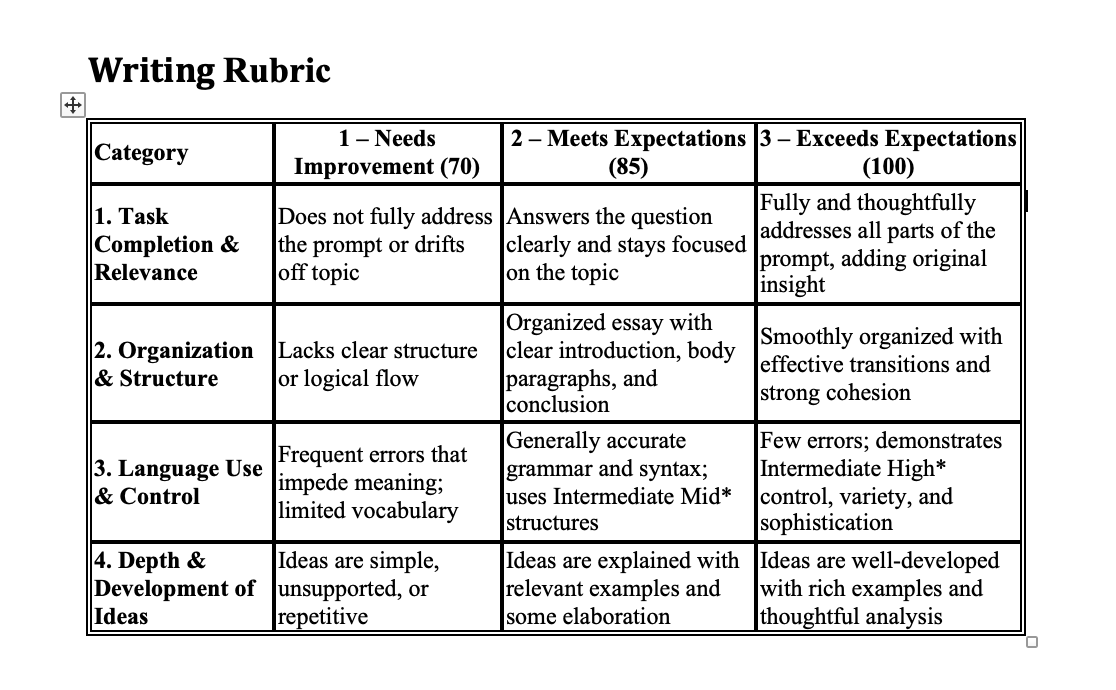
This morning, I revisited my rubrics with the goal of simplifying and clarifying them. The new framework uses three performance descriptors: Needs Improvement, Satisfactory, and Exceeds Expectations. The categories are rooted in ACTFL proficiency standards, providing students with concrete linguistic targets for their writing.
Although I still assign numerical values to meet reporting requirements, I see this system as a way to re-center attention on the writing itself rather than the arithmetic of grading. My hope is that this model reduces ambiguity while offering a shared language for discussing growth.
Students will have opportunities to conference with me to move from “Satisfactory” to “Exceeds Expectations,” and all writing will be completed in class to ensure authenticity. When I introduce this system later this week, I plan to frame it as an invitation—to see writing as iterative, to view feedback as formative, and to focus less on grades as endpoints.
Looking Ahead
Will this approach result in slightly higher grades? Possibly. But should higher grades be considered a problem if they reflect genuine engagement and revision? I don’t think so.
If students choose not to revise, that remains their prerogative—but for those who do, I want the path toward excellence to be clear, supported, and attainable. My ultimate goal is to reduce anxiety around grading, provide feedback that is actionable, and encourage reflection on the process of writing itself.
I’m eager to see how this shift unfolds—and whether reframing grades as narratives of growth rather than numbers of judgment can make my students’ writing experiences richer, more intentional, and more humane.
Just for Fun
Here is a look at what I’m working with. This is currently in draft form but I am excited to see what my students think next week!